In a mountain town suffocating under an unforgiving winter, an old, forgotten logging horse, dismissed as past her prime, holds the quiet strength that just might avert a disaster and rekindle a community’s lost hope.
Chapter 1: The Weight of Winter (The Forgotten Horse Who Saved a Mountain Town Origins)
The legendary and heroic winter tale of the forgotten horse who saved a mountain town began during the frozen months of 1923 in Oakhaven.
The wind howled a perpetual dirge through the skeletal pines, a sound as ancient as the mountains themselves.
Snow, thick and relentless, had swallowed the timber town of Oakhaven whole, muffling all but the most immediate sounds into a deep, frigid quiet.
Inside the drafty, timber-frame stable, Bess, an old logging mare, shifted her weight.
Her joints ached with the cold, a dull throb that had become a constant companion.
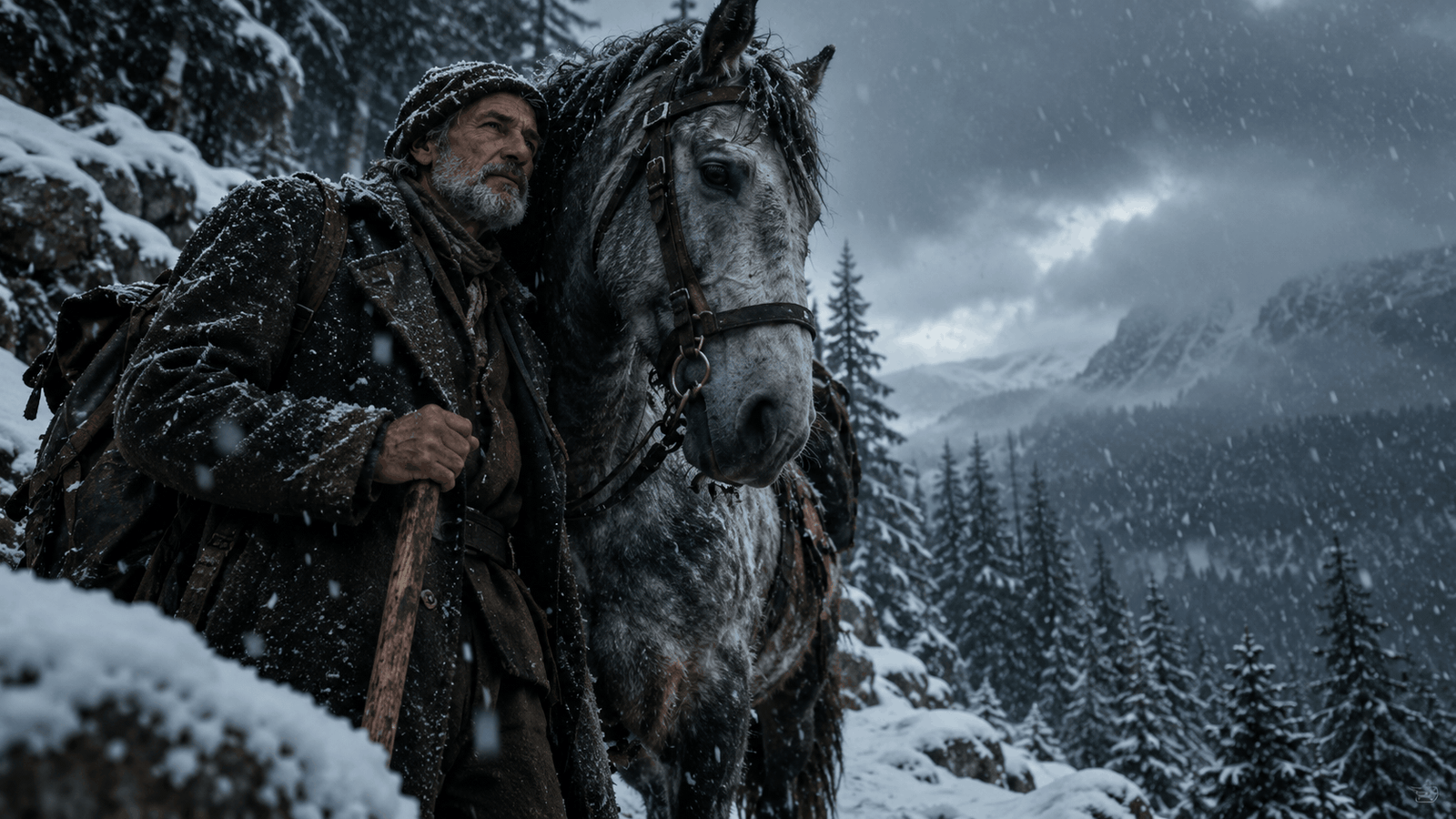
She was a ghost of her former self, her once-powerful frame now gaunt, her coat a faded dappled grey, matted in places despite Silas’s infrequent grooming.
He wasn’t cruel, not truly, but Bess was no longer profitable, just another mouth to feed through a winter that promised to be the harshest in living memory.
The scent of stale hay and her own equine musk filled the small stall, a familiar, comforting prison.
Outside, the world was a canvas of blinding white, the air so sharp it stung the nostrils.
Bess remembered the scent of fresh pine needles underfoot, the rhythmic pull of heavy logs, the satisfying creak of harness leather.
Now, only the dull thud of snow falling from overburdened branches punctuated the silence, and the distant, almost imperceptible rumble of the river, growing sluggish under its icy sheath.
Silas, a man forged from the same rugged stuff as the mountains, entered with a bucket of lukewarm water.
His boots crunched on the frozen earth of the stable floor, a sound Bess had learned to associate with the scant comfort of feed.
He didn’t speak much, not to her, not to anyone. His face was a roadmap of weathered lines, eyes the color of river stones.
He poured the water, a thin plume of steam rising in the frigid air.
Bess drank slowly, deeply, the warmth a fleeting comfort against the pervasive cold seeping into her very bones.
She watched him through half-lidded eyes, sensing his own quiet desperation, a tension that hummed beneath his stoic exterior.
This winter was different. It felt heavier, colder, more final than any before. Learn more about mountain logging traditions and draught horse history.
Chapter 2: Whispers of Disaster (The Forgotten Horse Who Saved a Mountain Town Discovery)
Sensing the deep vibrations of a fracturing river dam during the forgotten horse who saved a mountain town, Bess warned Silas of impending doom.
The snow continued its relentless descent, day after day, week after week, blurring the line between earth and sky.
Oakhaven became a tomb of white, its logging roads impassable, the telegraph lines long severed by the weight of ice.
Supplies dwindled, the general store’s shelves growing starker with each passing day.
A desperate quiet had settled over the town, replacing the usual boisterous camaraderie of the loggers.
Inside Bess’s stable, the air grew colder, the ice on the small windowpane thickening into an opaque shroud.
She felt it first in her hooves, a subtle, deep vibration that resonated through the packed earth.
It was a tremor, not of an earthquake, but something more insidious, a low, guttural hum emanating from the river gorge upstream.
Her ears swiveled, twitching towards the sound, her old instincts stirring.
She snorted, a plume of vapor frosting the air, a deep unease settling in her ancient bones.
Silas noticed her agitation during his evening rounds.
She was pacing, a restless energy in her usually lethargic movements, her eyes wide and dark.
“What ails you, old girl?” he muttered, his voice a gravelly whisper in the quiet.
He ran a hand over her flank, feeling the shiver that ran through her.
He had seen horses act strange before a storm, but this was different. This was a deeper, more primal fear.
Later that night, at the flickering lamplight of the general store, the men gathered.
Old Man Hemlock, the trapper, his face etched with concern, spoke in hushed tones.
“The ice upriver, it ain’t right. Heard a crack, louder than any thunder, just before the last big snow. Reckon that dam, the old one built for the sawmill years back, it’s holding more than it ever should. A break, and this whole valley gone.”
A collective gasp, then a terrified silence.
Silas, listening from the periphery, felt a cold dread seep into him.
He thought of Bess, her restless pacing, the low thrumming she seemed to sense.
Was it just an old horse’s jitters, or something more profound?
The thought gnawed at him, a tiny ember of doubt in the encroaching darkness. Explore our full archive of mountain folklore and animal hero stories.
Chapter 3: A Desperate Plea (The Forgotten Horse Who Saved a Mountain Town Archives)
Proposing an impossible journey along high mountain deer trails during the forgotten horse who saved a mountain town, Silas convinced the town to trust Bess.
Panic, a colder, more insidious enemy than the blizzard itself, began to grip Oakhaven.
The trapper’s grim warning had solidified into a terrifying certainty: the massive ice dam holding back the spring thaw and accumulated snowmelt was fracturing.
A scout sent upstream had returned, frostbitten and barely coherent, confirming the imminent collapse.
“There’s no getting out,” he croaked, his voice raw. “The passes are choked, the river a death trap.”
Despair settled over the gathered townspeople like a shroud.
Children whimpered, women clutched their aprons, and the men, usually so robust, stood with shoulders slumped, defeat etched onto their faces.
They were trapped, and the clock was ticking.
Silas, however, felt a different kind of stir.
He looked at the faces, desperate and lost, and then his mind drifted back to Bess.
Not the old, weary Bess of today, but the Bess of twenty years ago.
The Bess who had pulled a fully loaded sled of timber through a sudden, unexpected whiteout, navigating by instinct alone.
The Bess who had found a lost child in a blizzard when men had given up hope.
He cleared his throat, the sound rough in the heavy silence.
“There’s one way,” he began, his voice surprisingly steady.
“Old Bess. She knows the mountain better than any of us. There’s a faint deer trail, high above the gorge, might still be passable. If anyone can get a warning to the next logging camp, or even just set off a controlled slide to divert the main flow, it’s her.”
A ripple of disbelief, then outright scorn, spread through the crowd.
“That old nag? She can barely stand, Silas!” cried one man.
“She’d be dead before she cleared the first ridge!” another scoffed.
Silas’s gaze, however, held a fierce, unwavering conviction.
“She’s got grit, more than any of you give her credit for. And she feels it, the mountain’s anger. I’ve seen it in her eyes. We have no other choice. It’s a slim chance, yes, but it’s our only chance.”
The silence that followed was heavy, punctuated only by the distant, ominous groan of the strained ice.
Slowly, reluctantly, a few heads nodded.
Desperation had made them open to even the most improbable flicker of hope.
Chapter 4: The Ascent of Hope (The Forgotten Horse Who Saved a Mountain Town Confrontation)
Navigating steep precipices and blinding snow during the forgotten horse who saved a mountain town, Bess and Silas fought step by step to carry the warning.
The pre-dawn air was a living thing, biting and relentless, as Silas led Bess away from the hushed, anxious faces of Oakhaven.
A single, small leather pouch containing the warning note and a few rations was tied securely to Bess’s saddle.
The path, barely discernible under a fresh dusting of snow, rose steeply, winding through groves of snow-laden spruce.
Each step was a battle against the deep drifts, the crust of ice, and the sheer unforgiving incline.
Silas leaned into the wind, his breath pluming white, his old axe repurposed as a makeshift staff.
He watched Bess, her movements slow but deliberate, her head bowed against the wind.
Her nostrils flared, drawing in the frigid air, and he saw a spark of something he hadn’t seen in years: an ancient, innate focus.
She felt the subtle shifts in the snowpack, the hidden ice sheets beneath, her hooves finding purchase where Silas’s often slipped.
Her internal monologue, if horses could have one, would be a primal symphony of instinct and memory.
The weight of the world, of the town’s survival, rested on her aching joints, but a deeper, more profound purpose had awakened within her.
Hours bled into one another, marked only by the shifting quality of the pale, weak light.
The wind seemed to mock them, tearing at their clothes, whipping icy pellets into their faces.
At one point, Bess stumbled, her front leg sinking deep into a hidden crevice.
Silas’s heart leaped into his throat.
He hauled on the reins, his own muscles screaming, urging her, coaxing her with soft words he hadn’t known he possessed.
“Come on, girl. You can do it. Just a little more.”
With a mighty, shuddering effort, Bess pulled free, her breath coming in ragged gasps.
Her flank trembled, but her eyes, dark and resolute, met Silas’s.
In that moment, an unspoken pact solidified between them.
Not master and beast, but two weary souls bound by a shared, desperate mission.
The rhythmic crunch of their footsteps, the whisper of the wind, and the thud of Silas’s pounding heart were the only sounds in a world that felt both vast and terrifyingly lonely.
Chapter 5: The Echo of Hooves (The Forgotten Horse Who Saved a Mountain Town Resolution)
Averting the catastrophic flood through a controlled release during the forgotten horse who saved a mountain town, Bess returned to Oakhaven as a beloved hero.
Days later, a faint echo reached Oakhaven, not the roar of a bursting dam, but the distant, controlled rumble of a deliberate avalanche, a sound that spoke of engineered release.
A collective, trembling breath was held, then released in a wave of disbelief and overwhelming relief.
The waters had risen, yes, but diverted, controlled. The town was saved.
Silas and Bess returned in the quiet twilight of the following evening, shadows against the snow-draped peaks.
They were gaunt, exhausted, caked in ice and mud, but alive.
Bess’s head was still bowed, but there was a quiet dignity in her weary gait.
The townspeople, alerted by the first barking dog, spilled out of their homes.
They didn’t cheer, not in the boisterous way. Instead, a reverent silence fell.
As Silas gently removed Bess’s saddle, the warning note, crumpled but intact, was passed from hand to hand.
“She did it,” whispered one man, his voice thick with emotion. “The old girl she truly did it.”
Bess, once the forgotten, useless burden, was now the quiet hero.
Her stall, once neglected, became a place of pilgrimage.
Children brought her apples, women offered soft words and gentle brushes, and the men, even the most skeptical, regarded her with newfound respect.
Silas, usually so gruff, found himself speaking to her more, running a hand over her mane with a tenderness he hadn’t shown anything in decades.
He built her a new, warmer stall, piled high with fresh hay, and ensured she had extra rations.
Bess, in turn, seemed to carry herself with a renewed purpose, her eyes holding a deeper, knowing light.
The harsh winter had tested Oakhaven, revealing its fragility, but it had also unearthed a forgotten truth: heroism wasn’t always loud or grand.
Sometimes, it was quiet and steadfast, carried on four weary legs through an unforgiving wilderness, an echo of hooves in the vast, silent mountains, reminding them all of the profound strength found in the most unassuming hearts.