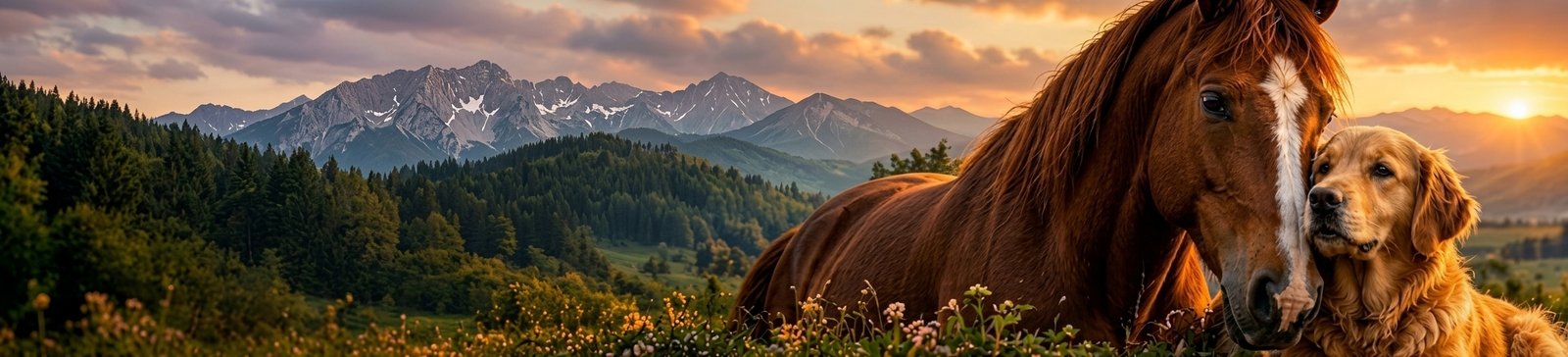
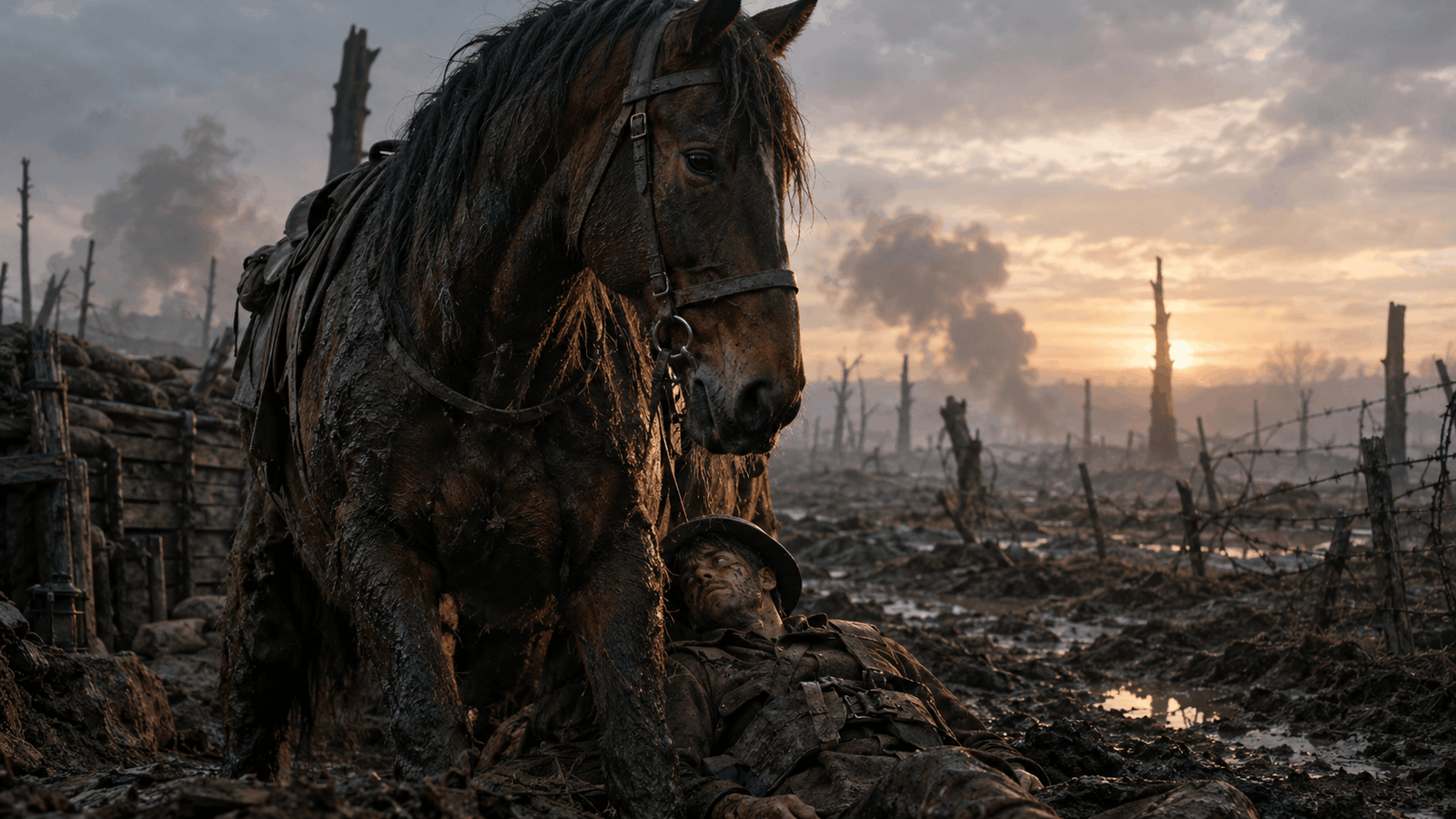
In the crucible of the Great War, a soldier’s steadfast horse defies the chaos of battle and the vastness of continents, driven by an unbreakable bond to reunite with the man he refuses to leave behind, proving that true loyalty knows no bounds.
Chapter 1: The Quiet Earth of Ashworth Farm (The Horse Who Refused to Leave His Owner Behind Origins)
The emotional and unforgettable story of the horse who refused to leave his owner behind began on the quiet pastures of Ashworth Farm in 1914.
The scent of damp earth and sweet hay was Thomas’s earliest memory, intertwined inextricably with the warmth of Storm’s flank.
Ashworth Farm, tucked into a gentle fold of the English countryside, was a symphony of quiet rhythms: the distant lowing of cattle, the rustle of wind through ancient oaks, the rhythmic snip of shears during lambing season.
But mostly, for Thomas, it was the soft sigh of Storm’s breath against his neck, the deep thrum of hooves on the pasture, a language understood without words.
Storm, a magnificent dark bay, with a starburst blaze on his forehead and eyes like polished obsidian, was more than just a horse; he was an extension of Thomas’s own soul, a silent confidante through sun-drenched summers and frosted winters.
Thomas, twenty-two and lean from years of farm labor, remembered the day Storm was foaled. A tempest had raged that night, tearing at the thatched roof of the barn, but in the morning, amidst the straw and the lingering scent of ozone, lay the tiny, trembling colt.
His mother, an old mare named Daisy, had nudged him towards Thomas, as if recognizing an inherent kinship. From that moment, a bond was forged, tempered by countless hours spent together: breaking ground for spring planting, galloping across dew-kissed fields, mending fences under a sky the color of bruised plums.
Thomas spoke to Storm not as an animal, but as an equal, sharing his dreams, his fears, the quiet anxieties that gnawed at a young man on the cusp of his future. Storm would listen, his ears twitching, occasionally nudging Thomas’s hand with his velvety muzzle, a silent affirmation of understanding.
Their morning ritual was sacred. Before the sun had fully chased the mist from the valley, Thomas would be in the stables, the comforting smell of horse and leather filling his nostrils. Storm would greet him with a soft nicker, his large eyes fixed solely on Thomas.
Together, they would walk the fields, Thomas’s hand resting on Storm’s neck, feeling the powerful muscles ripple beneath his palm. He knew every curve of Storm’s spine, every scar on his hide, every subtle shift in his mood.
Today, however, a new, unsettling tremor ran through the air, heavier than the usual morning chill. Whispers of war had grown into shouts, then into the insistent, demanding clang of recruitment bells in the village square. The world outside Ashworth’s peaceful embrace was tearing itself apart.
“They’ll need horses, Storm,” Thomas had murmured one evening, his voice heavy with a premonition of loss. He sat on a bale of hay, running a curry comb through Storm’s glossy coat, the rhythmic scrape a comfort against the rising tide of dread.
“Strong ones. Brave ones.” Storm had snorted, shaking his mane, as if dismissing the notion. But Thomas saw the apprehension in his eyes, a mirroring of his own fear. It wasn’t just the fear of battle, of injury, of death. It was the fear of separation from this creature, this anchor to his very being.
The day the letter arrived, thick and official, Thomas’s mother had wept silently into her apron. His father, a man of few words, had simply gripped Thomas’s shoulder, his eyes conveying a lifetime of unspoken anxieties.
Thomas was to report in a week. And they needed horses. Specifically, they needed strong, reliable farm horses. Storm, with his powerful build and unflappable temperament, was an obvious choice.
The thought was a dagger to Thomas’s gut. To take Storm to that? To the thunder and fire and screams of a distant, unimaginable war? It felt like a betrayal of their bond, a desecration of their quiet life.
He spent the last few days in a haze, each touch of Storm’s mane, each shared gallop across the fields, imbued with a bittersweet finality. He spoke to Storm incessantly, pouring out his heart, explaining the terrible necessity, the duty that pulled him away.
“You’ll be brave, my friend,” he whispered, his voice thick with unshed tears, burying his face in Storm’s neck, inhaling the familiar scent of horse and dust and honest labor. “You’ll come back to me. We’ll come back to Ashworth.”
Storm had stood still, a statue of equine stoicism, but Thomas felt the tremor in his powerful shoulders, the subtle shift of weight, as if Storm understood the gravity of their parting.
The air was thick with unspoken goodbyes, the weight of an uncertain future pressing down on the quiet earth of Ashworth Farm.
The final morning, Thomas led Storm from the stable, the reins feeling like a chain pulling him from his own heart. The sun, usually a herald of hope, felt cold and indifferent.
As they walked towards the waiting military convoy, Storm kept his head high, his ears swiveling, but his eyes, Thomas swore, were fixed on him with an intensity that promised an impossible return. Learn more about historic equine roles in military history and wartime service.
Chapter 2: The Thundering Maw of War (The Horse Who Refused to Leave His Owner Behind Discovery)
Entering the chaos of the Western Front during the horse who refused to leave his owner behind, Storm navigated explosions and separation while holding onto the memory of Thomas.
The journey across the Channel was a nightmare of swaying decks and the acrid smell of seasickness, a stark contrast to the open fields Storm knew.
But nothing, absolutely nothing, could have prepared him for the Western Front. It wasn’t just a place; it was a hungry, roaring beast, its maw gaping, spewing fire and iron.
The air, once clean and sweet with grass, was now a noxious cocktail of cordite, blood, and churned earth.
The sky, a canvas for Thomas’s dreams at Ashworth, was now a bruised, suffocating ceiling, perpetually weeping rain or choked with the black smoke of explosions.
Storm, with his innate equine sensitivity, felt the war before he truly saw it. The ground trembled constantly, a deep, resonant thrum that vibrated through his hooves, up his legs, and into his very bones.
The sounds were a cacophony of hell: the whine of shells overhead, growing to a shriek before detonating with a concussive CRUMP that rattled his teeth; the relentless, metallic stutter of machine guns, like monstrous, hungry insects; the guttural shouts of men, raw with fear and command.
He saw men fall, heard their cries, smelled the coppery tang of their blood. His finely tuned senses, once a gift for navigating the farm, now registered only danger, a relentless, overwhelming onslaught.
His separation from Thomas had been abrupt, a chaotic blur of orders and new handlers. One moment, Thomas’s familiar hand was stroking his mane, his voice a low, calming murmur in the chaos of a teeming supply depot.
The next, a gruff sergeant was yanking at his bridle, pulling him into a line of other terrified, requisitioned horses, destined for the grueling work of pulling artillery.
Storm had whinnied, a desperate, raw sound, straining against the unfamiliar hand, his eyes scanning frantically for Thomas’s retreating figure.
But Thomas was swallowed by the sea of olive drab uniforms, the churning mud, the pervasive, suffocating despair.
Days blurred into weeks, marked only by the relentless cycle of exhaustion, terror, and meager rations. Storm pulled wagons laden with ammunition through mud so deep it threatened to swallow his legs whole.
He hauled field guns across treacherous terrain, his powerful shoulders straining against the harness, his breath coming in ragged gasps.
The constant fear of shrapnel, of a misstep in a shell crater, of the sudden, blinding flash of an explosion, became a dull ache in his chest.
Yet, through it all, one thought, one image, remained seared into his equine mind: Thomas. His scent, his touch, the particular cadence of his voice.
It was a lifeline in the maelstrom, a singular purpose that kept him from succumbing to the omnipresent despair.
He observed the men around him, their faces etched with the same weariness, the same haunted eyes. They were different from Thomas, their hands rougher, their voices sharper.
They saw him as a tool, a beast of burden, not the loyal companion he was.
Often, in the brief lulls between bombardments, when the silence was almost as terrifying as the noise, Storm would stand perfectly still, his ears swiveling, his head cocked, listening.
Not for the distant roar of battle, but for a familiar step, a remembered whistle.
He would catch fleeting scents, a whiff of pipe tobacco, a particular kind of soap, that would briefly ignite a flicker of hope, only to be extinguished when the face attached to the scent was not Thomas’s.
One particularly brutal afternoon, during a frantic retreat, a shell landed dangerously close. The ground bucked beneath him, sending him sprawling.
The wagon he was pulling overturned, scattering its deadly cargo. Men screamed, horses panicked, rearing and whinnying.
Storm, disoriented and bruised, struggled to his feet, his heart hammering against his ribs. The harness had snapped.
For a moment, a wild, primal instinct to flee, to run from the noise and the death, surged through him.
But then, another instinct, deeper and more powerful, took hold. Thomas. He had to find Thomas.
He broke free of the tangled harness, ignoring the shouts of the soldiers trying to recapture him, and galloped away from the chaos, not towards safety, but towards the invisible thread that still bound him to his human, a thread that somehow, impossibly, stretched across this thundering, blood-soaked land. Explore our full archive of classic war stories and animal loyalty tales.
Chapter 3: A Shadow in the Trenches (The Horse Who Refused to Leave His Owner Behind Archives)
Whispers of an uncatchable bay roaming no-man’s-land during the horse who refused to leave his owner behind gave Thomas a fragile spark of hope in the trenches.
The mud was a living entity in the trenches, a cold, tenacious beast that clung to everything, seeped into everything, a constant, chilling reminder of the earth’s raw wounds.
Thomas, huddled in a dug-out whose walls wept perpetual damp, felt the mud in his boots, under his fingernails, in the very marrow of his bones.
It mirrored the pervasive grime coating his soul, a layer of despair and exhaustion that dulled the edges of memory, making the vibrant hues of Ashworth Farm seem like a dream from another life.
He hadn’t seen Storm since that chaotic day at the depot, and the silence from the horse lines, where other men spoke of their mounts, only deepened the hollow ache in his chest.
Was Storm alive? Was he even still whole? The questions were a torment, a slow, agonizing drip in the dark recesses of his mind.
Days were an indistinguishable blur of waiting, shelling, and the visceral horror of going “over the top.”
Nights were worse, filled with the ghosts of fallen comrades and the relentless echoes of past bombardments.
He found himself staring at the sliver of bruised sky visible from the trench, imagining Storm galloping beneath it, free.
But the reality was likely far grimmer. He had seen other horses, broken and emaciated, their eyes vacant, their spirits crushed by the unceasing demands of war.
The thought of Storm, so vibrant and full of life, reduced to such a state, was almost unbearable.
He clutched the small, smooth river stone he had taken from Ashworth, a last tangible link to home and to Storm, tracing its cool surface with a thumb grown rough and calloused.
One evening, as the last sliver of blood-orange sun bled into the horizon, casting long, grotesque shadows across the corrugated iron and sandbags, a rumour rippled through the company.
“Heard tell of a stray horse,” Private Miller whispered, his voice hushed, “a big bay, been seen roaming the no-man’s-land near sector seven. Wild as a banshee, won’t let anyone near it.”
Thomas’s heart gave a violent lurch. A bay. Wild. Unwilling to be caught. It sounded impossibly, wonderfully like Storm.
A spark, tiny and fragile, ignited within the desolate landscape of his hope. But then, the logical, brutal voice of war extinguished it.
There were countless bay horses. This was the front; animals wandered, escaped, got lost. It was foolish to cling to such a phantom.
Yet the seed was planted. He found himself scanning the ravaged landscape with renewed intensity during the brief lulls, his eyes searching beyond the shattered trees and barbed wire for any glimpse of movement, any familiar silhouette.
He saw shapes in the mist, heard phantom whinnies in the wind, each a cruel trick of his longing mind.
His comrades noticed his distraction, his sudden, almost desperate focus on the desolate expanse beyond their trenches.
“Still thinking of your old nag, eh, Thomas?” Sergeant Davies had grunted, not kindly. “Best forget ’em, son. Ain’t nothing out there but death.”
But Thomas couldn’t forget. Forgetting Storm felt like forgetting a part of himself, a part that was still innocent, still whole.
He remembered the early mornings at Ashworth, the thrill of Storm’s powerful stride beneath him, the wind in his hair, the world a limitless expanse of green.
Here, the world was a confined, muddy hell, and he was trapped, a prisoner of duty and circumstance.
The dehumanizing nature of the war chipped away at his sense of self, turning him into another cog in the vast, grinding machine of destruction.
But the image of Storm, the memory of their bond, was the one thing that resisted the erosion.
It was the last bastion of his humanity, a secret garden he retreated to when the horrors of the trenches threatened to consume him entirely.
He began to steal moments, whenever patrol duty allowed, to venture further, to peer over the parapet with a pair of borrowed binoculars, his gaze sweeping across the pockmarked land.
He saw only churned earth, discarded equipment, and the grim evidence of past battles.
Yet the rumour persisted, whispered from one weary soldier to another, growing into a legend of an uncatchable horse, a phantom steed of the battlefield.
Each mention, however vague, reignited the fragile flame of hope within Thomas.
He knew, with a certainty that defied all reason and the brutal reality of his surroundings, that if Storm was out there, if that bay horse was indeed his, then the impossible bond they shared would find a way to bridge the chasm of war.
He just had to believe it. He just had to survive.
Chapter 4: The Unseen Thread (The Horse Who Refused to Leave His Owner Behind Confrontation)
Tracking his master across battlefields and artillery barrages during the horse who refused to leave his owner behind, Storm relied on scent and instinct to survive.
Storm moved with the ghost of a purpose, his dark coat now matted with mud and dust, his once sleek flanks gaunt.
The thunderous maw of war had scarred him, physically and emotionally, but it had failed to break the unseen thread that bound him to Thomas.
His senses, honed to an almost supernatural degree by the constant threat of danger, were now entirely dedicated to a singular quest.
He navigated the treacherous landscape of the Western Front like a spectral guide, his hooves picking their way through splintered timbers, rusted wire, and the silent, grim monuments of forgotten battles.
He had learned the rhythm of the shelling, the tell-tale whistle of an incoming round, the brief lulls that offered a chance to move, to search.
He had become a creature of instinct and memory. The scent of Thomas, though faint, was his compass.
He recognized the smell of human sweat, of tobacco, of the specific oil used on British rifles, and would follow these faint traces, hoping one would lead to the unique signature of his master.
He grazed on sparse, tough grass in abandoned fields, drank from muddy puddles, and learned to find shelter in collapsed barns or the lee of a forgotten trench during the worst bombardments.
He was wary of men now, a deep-seated caution born of hunger, fear, and the countless attempts by soldiers from both sides to capture him.
They saw a resource, a means to an end; he saw only the absence of Thomas.
His journey was a testament to his profound intelligence and unwavering devotion. He had traversed miles of ravaged countryside, often crossing battle lines under the cover of darkness, his dark form merging with the shadows.
He had encountered other horses, wild and panicked, but none shared his singular focus. They fled from the war; he sought something within it.
Once, he had stumbled upon a small, isolated farm, its occupants long fled. An old woman, her face a roadmap of grief and survival, had emerged from the cellar, her eyes widening at the sight of the magnificent, wild horse.
She had approached him cautiously, offering a handful of bruised apples from her depleted stores.
Storm had allowed her to stroke his muzzle, her touch gentle, reminding him briefly of Thomas’s hand.
He ate the apples, but when she tried to lead him into a makeshift stable, he had gently pulled away, his eyes fixed on the distant, smoke-plumed horizon. He had a mission.
Days melted into weeks, then months. Storm’s physical form bore the marks of his ordeal: a jagged scar along his flank from a piece of shrapnel, a slight limp from a strained tendon, his coat dull and unkempt.
But his spirit, though weary, remained unbroken. He moved with a quiet determination, a ghost with a purpose, his ears constantly swiveling, catching the distant murmur of voices, the clatter of equipment.
He recognized the distinct sound of British commands, the familiar pattern of their bugle calls, and would gravitate towards them, always maintaining a safe distance, observing, searching.
There was a close call one freezing dawn. Caught in a sudden artillery barrage between opposing lines, Storm found himself trapped in a shallow crater, the earth erupting around him.
He could feel the searing heat of explosions, the ground vibrating violently. A piece of shrapnel whistled past his ear, narrowly missing him.
Panic threatened to overwhelm him, a primal urge to bolt blindly into the fray.
But then, an image flashed in his mind: Thomas’s face, his gentle smile, the light in his eyes.
A soft whinny, almost a plea, escaped him. He pushed himself against the crater wall, sheltering as best he could, refusing to give in to the chaos.
He would not die here. Not yet. Not before he found Thomas.
The barrage eventually lifted, leaving behind a smoking, pockmarked landscape. Storm, trembling but miraculously unharmed, slowly clambered out of the crater, his resolve hardened.
The unseen thread, stretched taut across the devastated land, pulled him onward, a silent, unwavering promise.
Chapter 5: The Echo of Hooves (The Horse Who Refused to Leave His Owner Behind Resolution)
Reuniting across the misty no-man’s-land in the horse who refused to leave his owner behind, Thomas and Storm finally returned home to Ashworth Farm.
The day it happened began like any other, a monotonous cycle of cold rations, the pervasive scent of stale sweat and fear, and the distant, constant rumble of artillery.
Thomas was on a solitary patrol, his rifle slung low, his gaze sweeping the desolate, fog-shrouded expanse of no-man’s-land.
The air was thick with mist, muffling sounds, distorting shapes. He moved cautiously, his boots squelching in the mud, each step a heavy testament to his exhaustion.
The rumour of the phantom bay horse had long since faded into the background of his daily struggle for survival, replaced by the grim realities of the present.
Suddenly, a shadow detached itself from the swirling grey, a large, dark shape moving with a cautious grace that seemed impossibly out of place in this landscape of ruin.
Thomas froze, his hand instinctively going to his rifle. But it wasn’t an enemy soldier.
As the mist thinned for a fleeting moment, a flicker of recognition, sharp and sudden, pierced through his weariness. A horse. A dark bay.
And something about its stance, the way its ears twitched, the familiar starburst blaze on its forehead, sent a jolt of electricity through his entire being.
It couldn’t be. It was impossible. Yet his heart hammered against his ribs with a desperate, burgeoning hope.
He lowered his rifle slowly, his voice, hoarse from disuse, barely a whisper. “Storm?”
The name, a fragile offering into the vast silence, hung in the damp air.
The horse’s head snapped up, its ears swiveling, its eyes, deep and knowing, fixed on Thomas.
A soft, querying whinny, a sound Thomas hadn’t heard in what felt like a lifetime, drifted towards him.
It was Storm. Gaunt, scarred, mud-splattered, but undeniably Storm.
The sight of him, standing there amidst the barbed wire and shell craters, was a miracle, a living testament to a bond that defied war itself.
Thomas took a hesitant step forward, then another, his eyes never leaving Storm’s. He saw the flicker of recognition in those dark eyes, a softening, a subtle relaxation of the powerful equine body.
Tears, hot and unexpected, streamed down Thomas’s grimy cheeks, cutting clean paths through the dirt.
“Storm,” he choked out, his voice thick with emotion, extending a trembling hand.
Storm responded with an immediate, powerful nuzzle against Thomas’s palm, his velvety muzzle seeking the familiar touch, his hot breath a comfort in the cold desolation.
It was a reunion beyond words, a silent communion of souls that had journeyed through hell and found their way back to each other.
The journey home was long and arduous, but they were together. Thomas, granted leave on account of his “unusual circumstances” and the sheer exhaustion etched into his face, led Storm away from the trenches.
They moved slowly, carefully, a silent pair against the backdrop of a slowly healing world.
The war raged on, but for Thomas and Storm, their personal war was over. Each step away from the front felt like shedding a layer of the war’s oppressive weight.
They slept under open skies when they could, sharing meager rations, the familiar routine of grooming and quiet conversation a balm to their wounded spirits.
Finally, after weeks of travel, they reached the familiar winding lane that led to Ashworth Farm.
The air was cleaner here, scented with wildflowers and fresh earth. The old farmhouse, though weathered, stood solid and welcoming.
Thomas’s parents, aged by worry and time, stood on the porch, their faces etched with disbelief and profound relief as they saw the familiar dark bay horse, his head resting against Thomas’s shoulder.
The war had changed everything, marked them all, but the core of their world, the quiet, unwavering bond between a man and his horse, remained.
As Storm gently nudged Thomas’s hand, a soft whinny of contentment escaping him, Thomas knew. He was home.
And Storm, the horse who refused to leave his owner behind, was home too. Their story was not just one of survival, but a testament to the enduring, unbreakable echo of loyalty that resonated through the quiet earth of Ashworth Farm, a bond stronger than any conflict.